Notes on Digital Feudalism
'Digital feudalism' has come to mind for me because it was written by as one of the possible features and in fact, the future of least resistance that we're heading toward, in the book The Last Economy by Emad Mostaque.
The knee-jerk reaction is that digital feudalism is going to be a bad thing - and I am not going to argue with that. I don't think it's a good thing, but I do think there's a lot of nuance here that we need to take a look at for a couple of reasons.
One of the reasons is that the future is never all one thing; even if we go through a phase transition, which is one of the arguments made in The Last Economy, you're going to have a mixture of futures. Part of the mix of those futures is this digital feudalism.
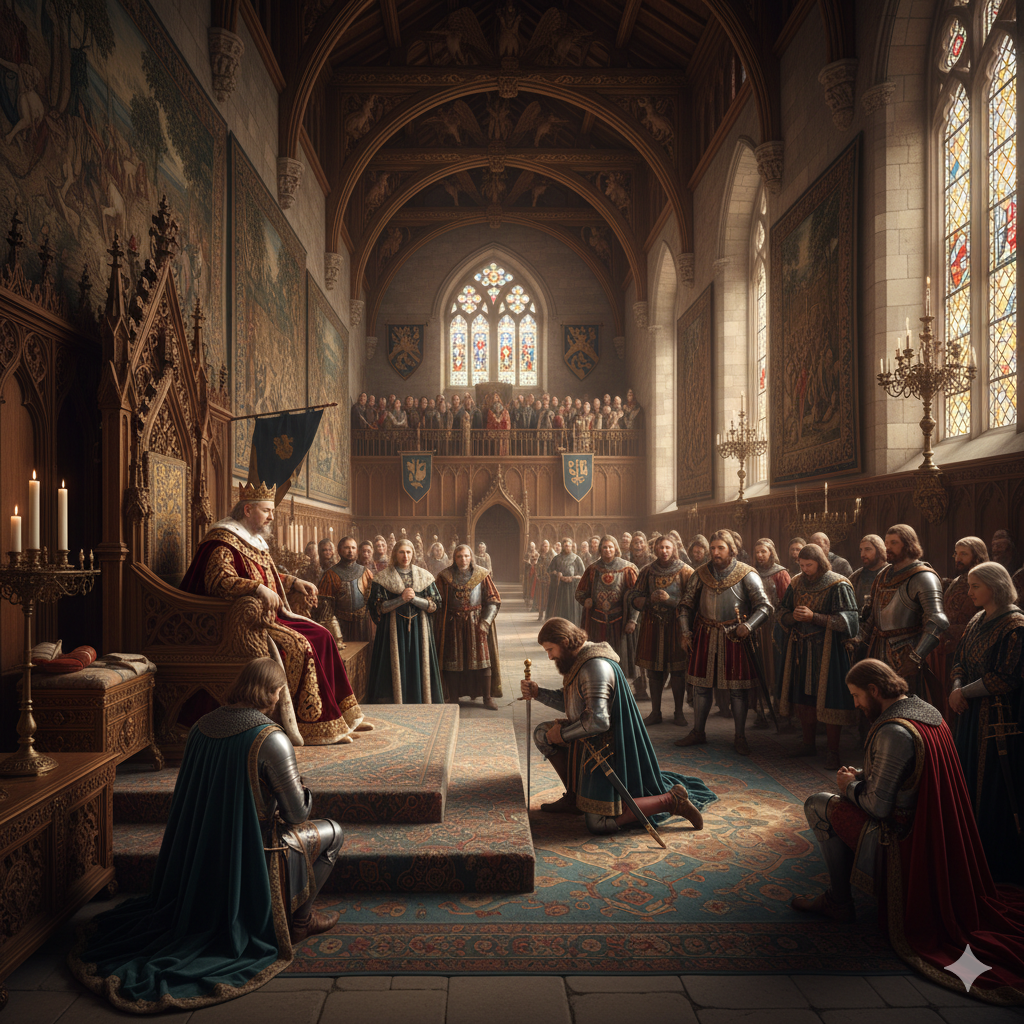
Feudalism in its antique form - the original form - describes a system where there was a king or prince, who would be supported by a C-suite (as it were) of barons swearing fealty to him. This is not just the case in Europe. The Chinese did the same thing. The Indians did the same thing. It's pretty much how power worked classically in the Eurasian context between the 5th and 18th centuries. One person held the power, who would delegate specific power relationships to their vassals. The vassals would swear fealty to their lord - from whom all power flowed - and forming a contract between them.
In the world of digital feudalism - according to The Last Economy - there's going to be perhaps five major powers, the big five AI companies. Presumably there will also be barons, who will captain other firms - possibly even governments. That's where power will be concentrated, and capital will be concentrated, until there is another phase change. Whether or not that comes to pass in every aspect, it still demands examination - to understand what happens to everyone else who is not described by this very exclusive set of power relationships.
The serf or peasant population in a typical feudal economy is generally at least 90% of the population, maybe as much as 95% of the population. If 90 to 95% of everyone is on the outs in this digital feudalism scenario, where the AI is fully resolved and makes everything - so we don't have to worry about necessities - then what's going on here?
Mostique makes the statement that everyone will be on Universal Basic Income. It's certainly what Sam Altman has been working toward with his WorldCoin, so there seems to be some juice to that idea. If we posit this future world where essentially 90 to 95% of everyone is on minimum UBI - basically just enough to keep things ticking over - what is that world like?
Because this is a world of UBI and not a world of the 10th century, the basics of existence are covered UBI. There's been a lot of research (and there's going to be a lot more research) on the economic logic of a kind of world like this, because certain things are very inexpensive, while others are very expensive.
The irreducible element tends to be the amount of human labour that's required to provide something. If you can get a machine to build you a house, then houses are cheap - if everything that goes into that house is created by a machines. If, on the other hand, there is something that is very delicate - perhaps eye surgery - it could be prohibitively expensive, because that would have to be brought to you by a person.
There are ways in which the economy will be able to be absolutely normal for people on the UBI: People will not have limitation - among a certain class of needs - in what they can buy or consume. But there are significant situations where it'll be very different.
This being the case, let's imagine a world where 90-95% of the population is on UBI.
Mostaque points to systems - ginning up right now over at Meta and Bytedance - which will be able to turn out an infinite series of infinitely compelling videos. People will just sit around watching TikTok and Instagram all day. I see the logic of that argument, though I'm not completely convinced by it, but that is where those systems are tending toward; they're creating more and more compelling content, they're creating an infinite supply of more and more compelling content, and - for certain people - it will be absolutely unthinkable to be able to look away from it. They will be completely contented, just sitting there and watching that all day long as their lives go by.
That's one set of people who constitute the peasantry within digital feudalism. While this might represent the largest number of people, they are also - for me - the least interesting, because they aren't really doing anything. They're just sitting there being consumers.
There are two other classes that I'm fascinated by - and these popped out at me immediately.
The first of those are artists. Artists create because they have no other choice - because it's just in them to create. The thing that we have seen in the 20th and 21st centuries is where the dole is enough for an artist to be able to live on, you get a thriving community of basically underground artists who are on the dole and doing amazing work as artists.
That's not an uncommon occurrence. I certainly happened in Berlin, certainly happened in London. It probably happened in New York and Sydney and Melbourne and in many other places. An artist will always be able to work within the constraints of the system they're presented with - as long as they can feed themselves and have a roof over their head. With UBI, where both of those are more or less guaranteed, they have a completely open playing field to be able to create and share works of art.
That is an incredibly interesting and unexpected outcome of this digital feudalism. We will likely enter a golden age of the arts because people will want to be making art, people who will effectively be competing with artificial art machinery that's consuming the attention of most everyone else. These artists will likely not be reacting to that, but will be informed by it - and doing different things.
That outcome looks to be a very profound ground for an exploration of what art is, what art is for, and how art operates - particularly because it's probably not going to have or necessarily need any commercial basis. At least a couple percent of the peasantry will be absolutely consumed with making art. Some of that art will be meta - documenting art and sharing art, not just creating art. There's also a whole culture around that, which we can see in every underground art community of the 20th and 21st centuries.
There's another set of people.
In a situation where the basics are provided, you now have an opportunity for a mendicant culture at a scale that we have never witnessed before, because for a certain percentage of people they have other things in mind. They won't be centered on material pursuits - so long as a basic material substance is provided for. They're going to focus on other things that are important to them.
Some of those individuals will be internally focussed; in other words, one's growth as a human being, however you define that. Others will be externally focussed - helping other people grow, however you want to define that. (There naturally will be a large crossover between these two.)
Mendicant culture has been with us for over two thousand years. Buddhists in India, Christian monks and nuns in Europe - people running hospitals, tending the poor and sick, providing care for people, doing the teaching; all of these tasks that we think of as being central and essential to what makes a civilisation healthy and worthwhile. These medicants, because of decisions they're making about their own personal growth, are also making decisions around the growth of their communities and the people in those communities.
That's Christian piety. It's Buddhist ethics.
There's always been a small percentage of people who have been intrinsically, deeply drawn to that kind of sacrifice, who say, "Yes, I'm going to put myself to work for others." Once you remove the basic barriers to subsistence - so people don't actually have to work to survive - they can work for others.
Whether a mendicant lifestyle becomes more enticing is an open question - it's going to depend on whether people favour their own personal growth over just sitting back and letting the vibes wash over them. We don't know how that will play out: I'm putting myself in the camp of the of the digital mendicant, because I can see that being a very nice outcome: living a life of service and personal growth, and not having to worry about the externalities while I'm doing that.
The vow of poverty that all nuns and monks make - whether they're Christian or Buddhist - is possibly hardest thing for us to be able to entertain as moderns. How would you do that? Why would you do that? Even chastity, in some ways, seems a more sensible vow than poverty, but in digital feudalism, poverty is not really the same thing anymore: you've got your alms being provided by the machines. Now you can dedicate yourself to the care of your own soul, the care of other souls, and the care of the people.
Whether digital mendicants make up percent or a half a percent or even a tenth of percent of the entire population, it's going to be a different thing than anything we've seen in the last century. They will be providing care - particularly the human care that would be very expensive otherwise - to a vast population who would otherwise be unable to afford it. That's not new, even if the need for it will be.
In this moment we seem to be moving forward while simultaneously recovering a older form of culture. Digital feudalism, with its power structures and vast peasantry, appears horrible and oppressive in its own very new way, while simultaneously clearing the space for some interesting elements of earlier cultures. That's something we need to take a look at. No matter how all of this evolves down over the next hundred million seconds - when things really will change a lot - these will be elements in that world.